

Del 4 al 8 de marzo
Stand 7A13
Para esta nueva edición de ARCO, la Galería Álvaro Alcázar toma el mar como eje conceptual del stand. Un territorio abierto, cambiante, que permite tejer un diálogo común entre las prácticas y lenguajes de todos los artistas presentes. Más allá de su dimensión paisajística, el mar aparece aquí como un espacio simbólico y político: un lugar de tránsito, de memoria y de transformación constante.
La propuesta plantea un recorrido por miradas muy distintas que, desde registros y sensibilidades diversas, encuentran en el mar un punto de encuentro. La exposición invita a pensar tanto desde lo poético como desde lo crítico: el mar conecta y separa, desplaza y reúne; ha sido escenario histórico de intercambios comerciales —desde las rutas de especias del siglo XVI— y hoy concentra algunas de las tensiones más urgentes de nuestro tiempo, como las migraciones, el comercio global, la crisis ecológica o los conflictos geopolíticos.
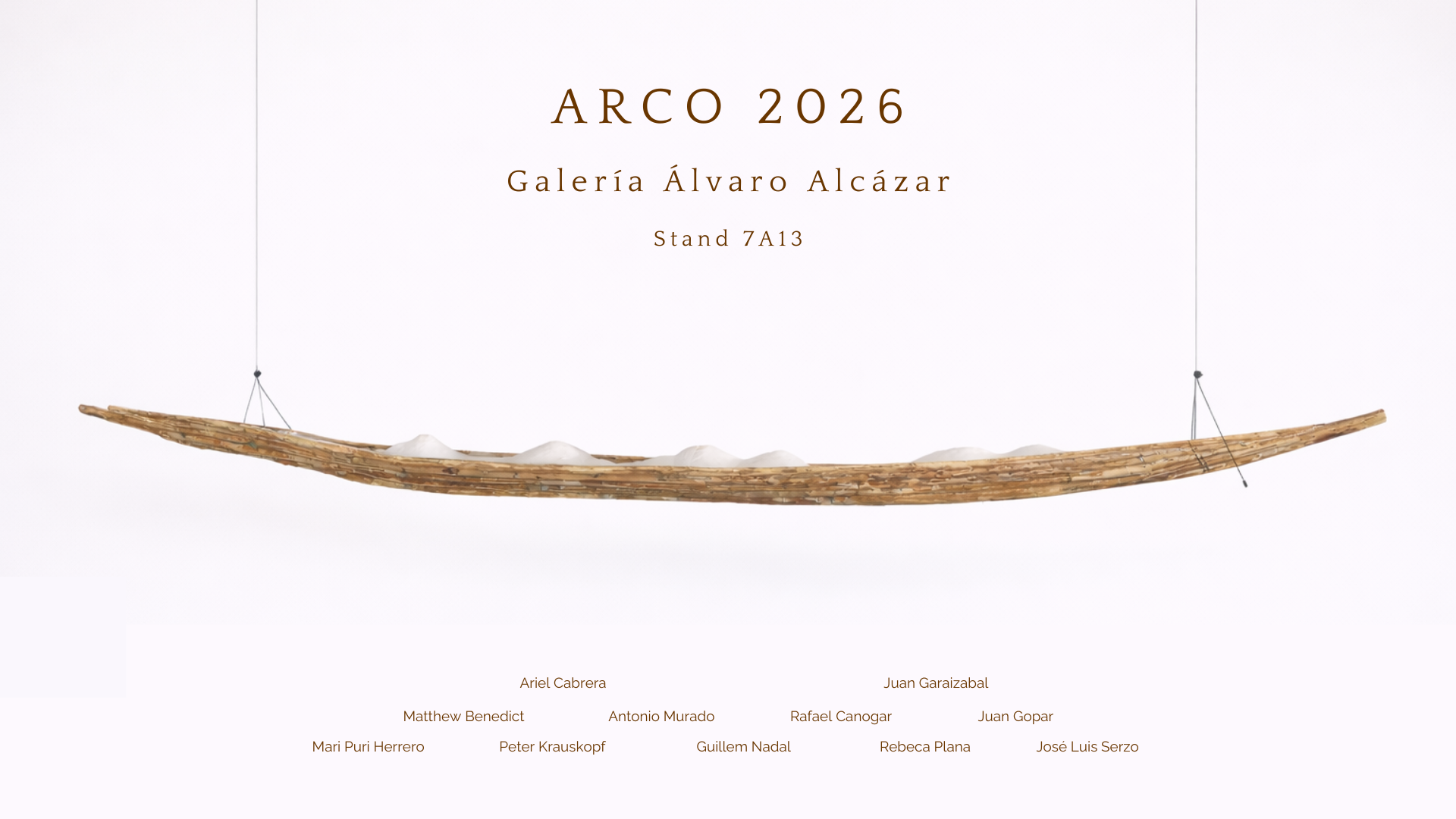
Desde una relación directa con el territorio, Guillem Nadal aborda el agua en series como Illes Robades, donde barcas de madera transportan islas de sal destinadas a disolverse. Estas piezas construyen un mapa efímero que remite a la fragilidad del paisaje y a la naturaleza transitoria de la materia. Juan Gopar presenta La isla taller, una instalación en la que el artista lanzaroteño convierte el arte en una práctica cotidiana y profundamente humana, hecha con materiales de la isla y la costa, y donde el proceso creativo surge del diálogo con el entorno.
Mari Puri Herrero propone un relato más íntimo, en el que la figura humana se enfrenta al mar como metáfora de un viaje interior. Una presencia casi espectral ocupa el primer plano, mientras el fondo marino funciona como espacio de proyección emocional y psicológica.
Desde un registro narrativo, José Luis Serzo presenta una escultura de La historia más bella jamás contada, donde despliega un imaginario vinculado al naufragio como metáfora del subconsciente. Por su parte, el artista neoyorquino Matthew Benedict retrata una playa urbana de Provincetown, donde la actividad pesquera del bacalao se integra en el paisaje cotidiano de la ciudad. A partir de archivos e iconografía histórica, la obra conecta mar, historia local y memoria colectiva. El cubano, Ariel Cabrera construye un collage pictórico y casi cinematográfico donde historia, memoria y ficción sesuperponen para confrontar la fragilidad humana —y la realidad cubana— frente a la inmensidad simbólica del mar.
La obra de Rafael Canogar, desde la abstracción, aporta una mirada más esencial y gestual, mientras que Antonio Murado explora el imaginario marítimo a través de una metáfora musical. También abstracta, la pintura de Peter Krauskopf parte de experiencias visuales reales que transforma en imágenes difíciles de verbalizar. Su trabajo dialoga con el mar como experiencia física y emocional: una presencia concreta que, al mismo tiempo, escapa a la descripción. En Thalassa, Rebeca Plana transforma el agua del Mediterráneo —inspirada en la DANA— en un paisaje abstracto y emocional de grafito negro que encarna memoria, pérdida y renacimiento como fuerza de transformación.
En el plano escultórico, Juan Garaizabal, fiel a su línea de traer la arquitectura de la memoria al presente, muestra una obra ya desaparecida, que alude a las influencias cruzadas entre Oriente y Occidente, entendiendo el mar como espacio histórico de intercambio y transmisión cultural.
En conjunto, la propuesta plantea el mar como un espacio de resonancia común: un lugar donde convergen historia, experiencia y ficción, y desde el que pensar el presente a través de prácticas artísticas diversas pero profundamente conectadas.
From 4 to 8 March
Booth 7A13
For this new edition of ARCO, the Álvaro Alcázar Gallery has chosen the sea as the conceptual focus of its stand. The sea is an open, ever-changing territory that enables a shared dialogue between the artistic practices and languages of all the artists present. Beyond its geographical aspect, the sea is presented here as a symbolic and political space: a place of transit, memory, and perpetual change.
The exhibition offers a journey through a variety of perspectives, which, despite their different origins and sensibilities, converge on the sea. The exhibition invites us to consider the sea both poetically and critically. It connects and separates, displaces and reunites. Historically, it has been the scene of commercial exchanges, such as the spice routes of the 16^(th) century, and today it is at the centre of some of the most pressing issues of our time, including migration, global trade, the ecological crisis and geopolitical conflicts.
Guillem Nadal’s work explores the relationship between humans and the land, as seen in series such as Illes Robades, where wooden boats carry salt islands that are destined to dissolve. These pieces construct an ephemeral map that refers to the fragility of the landscape and the transitory nature of matter. Juan Gopar presents La Isla Taller (The Workshop Island), an installation in which the Lanzarote-born artist transforms art into an everyday, deeply human practice. Created using materials from the island and the coast, the creative process in this work arises from dialogue with the environment.
Mari Puri Herrero presents a more intimate narrative in which the human figure stands facing the sea, symbolising an inner journey. An almost spectral presence occupies the foreground, while the seabed serves as a space for emotional and psychological projection.
From a narrative perspective, José Luis Serzo presents a sculpture entitled ‘La historia más bella jamás contada’ (The Most Beautiful Story Ever Told), in which he unfolds an imaginary world linked to shipwrecks as a metaphor for the subconscious. Meanwhile, New York artist Matthew Benedict portrays an urban beach in Provincetown, where cod fishing forms part of everyday life in the city. Drawing on historical archives and iconography, the piece connects the sea, local history and collective memory. Cuban artist Ariel Cabrera creates a pictorial, almost cinematic collage in which history, memory and fiction overlap, confronting human fragility and Cuban reality with the symbolic immensity of the sea.
Rafael Canogar’s abstract work provides a more essential and gestural view, while Antonio Murado explores the maritime imaginary through a musical metaphor. Peter Krauskopf’s abstract painting is based on real visual experiences that he transforms into images that are difficult to verbalise. His work engages with the sea as both a physical and an emotional experience: a tangible presence that, simultaneously, defies description. In Thalassa, Rebeca Plana transforms the waters of the Mediterranean — inspired by DANA — into an abstract and emotional landscape of black graphite, embodying memory, loss and rebirth as a transformative force.
In the realm of sculpture, Juan Garaizabal remains faithful to his approach of bringing the architecture of memory into the present. He displays a piece that no longer exists, alluding to the cross-influences between East and West and viewing the sea as a historical space of cultural exchange and transmission.
Together, these works present the sea as a space of common resonance, where history, experience, and fiction converge. They offer a perspective on the present through diverse yet deeply interconnected artistic practices.